

Urinary Tract and Oncology Prevention: the importance of acting before symptoms
Urinary tract cancers, particularly bladder cancers, represent a major oncological challenge in Italy, especially in the male population over 40 years old. Often silent in the early stage, they only manifest with symptoms when the disease is already advanced, compromising the effectiveness of treatments. This is why prevention and early diagnosis play a crucial role.
Bladder cancer: a development not to be underestimated
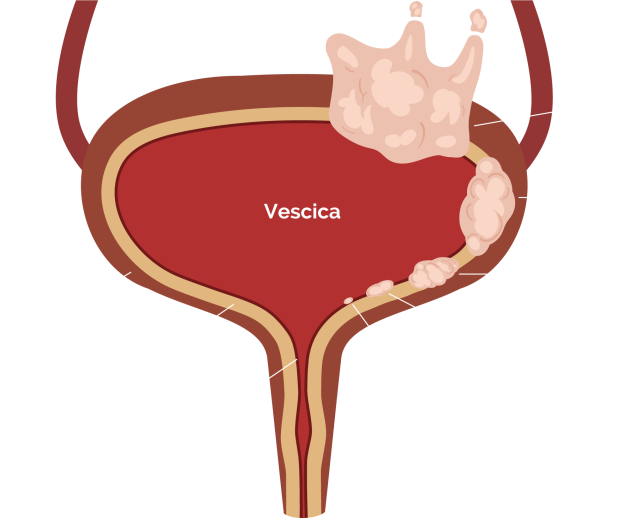
As shown in the infographic below, bladder cancer can present in different developmental stages:
- Stage 0 - Non-invasive papillary tumor: it develops only on the mucosal surface, without penetrating the underlying tissues.
- Stage 1 - Invasion of the lamina propria: the tumor penetrates into the first layers, increasing the risk of recurrence and progression.
- Stage 2 - Invasion of the detrusor muscle: the stage when the neoplasm becomes muscle-invasive, requiring more complex surgical treatments.
- Stage 3 - Extension into the perivesical adipose tissue: a sign of a more advanced and aggressive tumor.
- Stage 4 - Invasion of adjacent organs: the tumor involves primary organs such as prostate, uterus, vagina or pelvic wall, with a severe prognosis.
Detecting a tumor in Stage 0 or Stage 1 can make the difference between conservative therapy and more invasive interventions.
- Stage 0 - Non-invasive papillary tumor: it develops only on the mucosal surface, without penetrating the underlying tissues.
- Stage 1 - Invasion of the lamina propria: the tumor penetrates into the first layers, increasing the risk of recurrence and progression.
- Stage 2 - Invasion of the detrusor muscle: the stage when the neoplasm becomes muscle-invasive, requiring more complex surgical treatments.
- Stage 3 - Extension into the perivesical adipose tissue: a sign of a more advanced and aggressive tumor.
- Stage 4 - Invasion of adjacent organs: the tumor involves primary organs such as prostate, uterus, vagina or pelvic wall, with a severe prognosis.
Detecting a tumor in Stage 0 or Stage 1 can make the difference between conservative therapy and more invasive interventions.
Urine24: an innovative tool for early diagnosis
The Urine24 service is designed to offer a simple, safe, and scientifically advanced solution for early detection of urinary tract cancers (kidney, ureter, bladder) through urinary cytology examination:
- Independent urine collection on three consecutive days.
- Specific fixative to preserve cells.
- Microscopic analysis with reporting by experienced pathologists.
- Classification according to the international method The Paris System.
- Report emailed in a few days.
Because of its noninvasive approach and high diagnostic sensitivity, Urine24 is particularly recommended for:
- People with symptoms such as hematuria (blood in the urine).
- Smokers, at risk for accumulation of tobacco metabolites in the bladder.
- People exposed to chemicals or pollutants.
- Patients with previous urologic malignancy.
- Anyone over 40 years of age.
- Independent urine collection on three consecutive days.
- Specific fixative to preserve cells.
- Microscopic analysis with reporting by experienced pathologists.
- Classification according to the international method The Paris System.
- Report emailed in a few days.
Because of its noninvasive approach and high diagnostic sensitivity, Urine24 is particularly recommended for:
- People with symptoms such as hematuria (blood in the urine).
- Smokers, at risk for accumulation of tobacco metabolites in the bladder.
- People exposed to chemicals or pollutants.
- Patients with previous urologic malignancy.
- Anyone over 40 years of age.
Conclusions
Today's prevention is tomorrow's well-being. Urine24 is an invaluable ally in detecting cancer cells in urine in time, allowing targeted investigations or treatments to be initiated as early as the early stages of the disease.
If you are a health professional, an at-risk patient, or simply a health-conscious person, don't wait for symptoms to appear. Prevention begins with a simple act: a urine test.
If you are a health professional, an at-risk patient, or simply a health-conscious person, don't wait for symptoms to appear. Prevention begins with a simple act: a urine test.

